Showing posts with label Park Flyer. Show all posts

Tuesday, March 20, 2018

I Think I’ll Just Wing It. Pt.4

Let's talk Fuselage.

When building the Fuselage for an airframe you have a few things to consider or at least I did when designing this. First off how will it land? Sailplanes and gliders usually do not have any landing gear with the exception of a nose roller to help it slide. In the RC world, a lot of aircraft are called "belly landers" They might be somewhat scale planes, or profile scale but no gear. Why? Well for one it saves weight but another issue is the punishment landing gear goes through on RC aircraft. One hard landing on some planes tears into the fuselage from the way it is designed. Even in a perfect landing long grass can be a real challenge not to nose the plane over breaking props, motor mounts etc. Imagine in scale, you are landing in a 10' high cornfield. So when there is no gear you hand launch, which can take a bit of practice and when hand launching pusher prop types it takes a bit of a dance to keep from getting bit. This all depends on where you have available to fly, I am using a landing gear since I have a few hard surfaces available I can take off and land from.


The next thing to consider is where your gear will go since I am doing this from scratch I have no point of reference as to where the weight of gear should go, the center of gravity etc. So I need to not only allow room for gear but have some latitude to move it around to achieve a proper center of gravity balance.


I used a basswood stick 6mm x 610mm as the rear fuselage, the foam I add is only to lessen drag a bit and give me a wing mount. I used some lightweight plywood for my motor mount/firewall. The stick is basically the datum line of the aircraft.
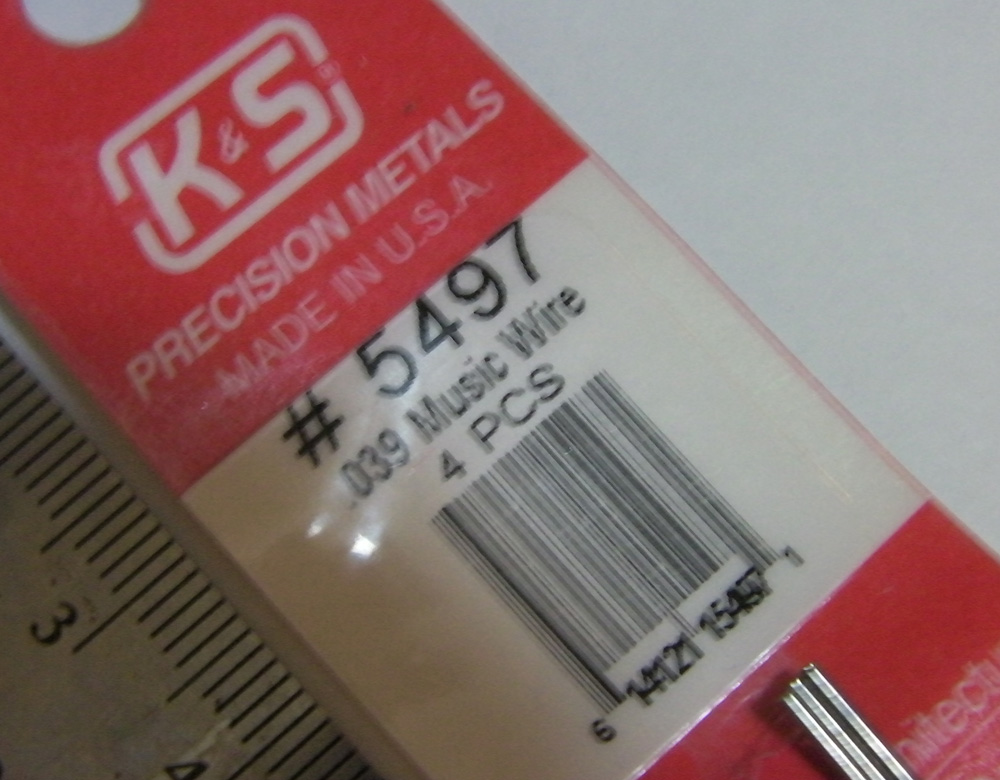


The landing gear is .039 music wire bent to give some shock absorption to my gear. I used some scrap light ply to make a reinforcement to sandwich wire to main stick. I grooved stick slightly to allow the wood plate to fit flat. I used regular Titebond 2 wood glue. Keep in mind using only glue you need, it is amazing how much gratuitous use of glue can add, and we want as little weight as possible added.


I could put a small section of bent music wire in the tail to make a taildragger but sometimes trying to steer on the ground can be a challenge when all you have is the rudder and prop wash to steer. I will show later how I make the tail steerable.

Lastly, how will the main wing mount? Wings have incidence which is the angle of attack it has, higher on the leading edge with a 4-7 degree drop at the trailing edge of the main wing. I am going to use foam board sides of the fuselage to create the wing mount and its incidence which I am going to go with 5 degrees.

Next will be the Tail Surfaces...

-Hobby Dude

Monday, March 19, 2018

I Think I'll Just Wing It. Pt.3

With any Project, I like to Establish my goal first so here we go.

My goal is to build an Electric-powered park flyer from both items I already have that are fairly inexpensive to buy or easily found at discount, dollar and hardware stores. My goal weight is 8 ounces  (227 grams) based on the power system I already have.

Let's start with the gear I have:

I already have a Transmitter capable of multiple model memory from long ago but most TX systems are really inexpensive now. My motor is an Outrunner type meaning the outer body including magnets rotate while the winding of wire stay stationary unlike a typical armature/can style motor. This is also a Brushless motor, yep no brushes and it is also a 3 phase motor. A lot more efficient than brushed, less drag due to no brushes. They produce 2, 3 and many more times the power of an equal sized brushed motor supplied by the same voltage and current.

When looking at motor/thrust/watts consider this; a 2 cell Lipo battery is labeled 7.4 volts but when fully charged measures 8.4 volts. Think of this of a full gas tank. 7 volts is a near empty tank. At around 7 volts the plane is going to be very slow maybe start to be harder to fly as it is putting out less power from less voltage and ability to handle bursts of current draw diminish greatly. Most speed controls have a voltage cutoff to save the batteries. In this way, they behave differently than their fuel powered counterparts. So when looking at the table below this explains why you see both a 7 and 8-volt reading.

The motor is rated at 40 to 60 watts yielding between 220 and 340 grams of thrust. So here is how I determined the goal weight:

I do not know the origin but long ago I was taught the "Watts per pound" rule and whether or not it came from anywhere credible I can vouch that it is proven guideline.
  • 50W/lb or less - very lightweight low wing loading trainer or slow flyer.
  • 50 to 75 W/lb - light powered gliders, basic park flyers, and trainers, classic biplanes and vintage ('Old Timer') type planes. Some of these can fly on the minimum if they are "belly landers" with no landing gear.
  • 80 to 125 W/lb - general sports flying and basic/intermediate aerobatics. Many scale (eg warbirds) subjects suit this power band.
  • 120 to 175W/lb - more serious aerobatics, pattern flying, 3D and scale EDF jets.
  • 180 to 200+W/lb - 3-D Planes, fast pattern planes, pylon racers,  faster jets and anything that needs serious non-scale power.
Just to put this in perspective 1 horsepower is equal to 746 watts.

As I stated above my goal weight is 8 ounces/227 Grams, and the motor at a minimum is rated for 220 grams of thrust, this means I should have  1:1 or greater thrust to weight ratio of about 80 watts per pound. Using the list above I should have more than enough power and some wiggle room with what it will weigh in the end.  We call this "AUW" or "all up weight", essentially everything that is going in the air.

My battery is a 2s1p or 2 cell lipo 7.4 volt 300mah 30C and I will explain later what all that means when it comes time to power up.

I will use 3 servos to control Rudder, Elevator, and Ailerons. Beyond that, there is the wheels I still need to make,  receiver, speed control or ESC (electronic speed control), prop, pushrods and control horns. So far my airframe parts and electronic gear weigh roughly 138 grams/4.8 ounces and I still have hardware and wheels to weigh in so I think I am going to make goal weight.

The airframe is next...
  • Hobby Dude

Sunday, March 18, 2018

I think I will just wing it.

The problem with me is that even if I know a pun is bad I will still use it.

I have played with all of the activities found in a hobby shop except maybe collecting beanie babies and scrapbooking and I don't think that really needs an explanation as to why. I do love the plastic world but if you have ever done any radio control hobbies there is another dimension enjoyed with that type of modeling. I have built and raced on road cars, off-road cars, rock crawlers, and few of the more scale RC stuff like Tamiya offers. I grew up with my father introducing Control Line Planes and spent a lot of my paper route money on little Cox .049 control line planes. Mustangs, Spitfires, and Warhawks, I had a coffee can full of spent .049 engines and cut and bruised fingers from the spring starters. I later played a bit with a nitro RC plane but I was going through the common struggle of finding a place big enough to fly without paying to join a club and getting to participate in the nonsense of clubs. Years later about the time Electric Park flyers came out I started managing a hobby shop.


The aspect of going to a ball field with smaller quieter planes was a huge benefit to being able to fly more and become a better flyer. I flew a lot and became the local guru on electrics the local hobby shop.

As a result, I later changed jobs to a hobby wholesale job and had a hand in designing and testing many products for electric planes and helis. Had my share of trade shows and events even made it to the gigantic airfield in Muncie Indiana joining the Compass Factory Heli Team at the amateur aircraft headquarters for the Huge Heli Fun/Fly Competition. I designed ducted fan jets, few trainers, and rarely met a kit or ARF(almost ready to fly) that I did not modify.


Recently the bug to build a plastic airplane kit started growing and like so many times in the past I think why not build something to fly. So I am digging into the depths of my math mind for what I use to know and I am going to build a park flyer out of some really basic materials and log the build here. I looked at current kits and I don't want to get into a long detailed build or some overpriced kit or ARF. I had the most fun flying with the basic airframe.
I have a basic outrunner I can use a 2cell pack(7.4v nominal) that should give me around 9-10 ounces of thrust and as a general rule 1:1 thrust to weight ratio is good for 3-d flying and aerobatics so if I can keep the AUW(all up weight) around 12 ounces it should fly great being is my intent is to build a sport flyer. The AUW is equal to the airframe, servos, radio gear, prop etc. I am going to use a piece of foam board from the dollar store for a wing and both stabilizers and The skeleton is a  6mmx610mm stick. I know all my posts so far are plastic scale cars but I am Hobby Dude so I have to change it up a bit. If anyone ever wanted to cross over into RC from scale plastic ask questions as much as you want and follow along as I build something fly-able out of cheap supplies. I will explain electric motors, Lipo batteries, charging, Speed control, servos and plane setup.

  • Hobby Dude